Most disease outbreaks in home aquariums arrive with a new fish. The fish looked fine in the shop, it went straight into the display tank, and two weeks later everything has white spots. A quarantine tank breaks that chain. New arrivals live in it alone, where you can watch them, treat them in a small volume of water if needed, and keep any parasite away from the fish you already have.
Why it matters
Ich, the white spot parasite, gets into tanks with new fish, and also with substrate and plants, according to the University of Florida’s extension sheet on the disease.1 Once there, it multiplies fast: a single encysted stage can divide into as many as 1,024 new parasites.1 The Merck Veterinary Manual lists lethargy, clamped fins and darker color as early signs, with white dots often visible on the skin.2
Velvet is quieter and often more dangerous. Merck describes small golden spots on the skin, and notes that when the parasite is only on the gills, nothing shows at all.2 Flukes and leeches come in on fish and plants too,2 and Tropical Fish Hobbyist gives the example of Camallanus, a contagious intestinal worm that only showed up after purchase in a fish that looked healthy.3 None of these is reliably visible in the shop.
How long to quarantine
The University of Florida recommends a minimum of 30 days for new fish.1 Aquarium Co-Op recommends four to six weeks, counted from the last time you saw a symptom or a death, not from the day you bought the fish.4 Tropical Fish Hobbyist quotes three to four weeks as a good period.3
The reason for a month rather than a week is the parasites’ life cycles. At 75 to 79°F, ich completes its life cycle in about three to six days, and longer in cooler water.1 Velvet takes about two weeks under ideal conditions.5 A month gives several full cycles for a hidden infection to show itself.
What size tank
A quarantine tank does not need to be as big as the fish’s permanent home, and less water means less medication if you have to treat.4 For most small community fish, a 10 gallon is the usual choice. Practical Fishkeeping’s own example setup is a tank about 18 by 10 by 10 inches, roughly 8 US gallons.6 Tropical Fish Hobbyist adds the obvious exception: large or fast-swimming fish need a bigger quarantine tank.3 For angelfish, larger cichlids or a group of rainbowfish, a 20 gallon long or 29 is more realistic.
Setting it up
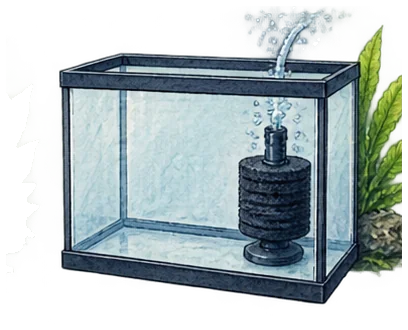
- Sponge filter. Gentle mechanical and biological filtration plus extra aeration, in one cheap unit.6
- Heater. Sized as for any tank; see our heater guide. A 50 W heater suits a 10 gallon in a heated room.
- Bare bottom. Practical Fishkeeping advises no substrate, because part of some parasites’ life cycle is spent in it.6 A bare floor is also easy to siphon and to see waste on.
- Somewhere to hide. Sick fish want to hide, and shelter makes them calmer.4 Use something you can disinfect: plastic plants, a length of PVC pipe, a clay pot. Avoid porous items such as lava rock, which pathogens can get into.3
- Low light. Bright light stresses sick fish and breaks down some medications.6
- A lid. Stressed fish in an unfamiliar tank may jump.
- Separate tools. Keep a net and siphon just for the quarantine tank.3 Ich spreads on shared equipment such as nets.2
Keeping the quarantine filter cycled
An empty tank has no bacteria, and a new fish in an uncycled tank is exposed to ammonia on top of the stress of moving. There are two easy fixes. Practical Fishkeeping suggests keeping the quarantine tank’s sponge running inside the filter of your main tank, so it is colonized and ready when you need it.6 Tropical Fish Hobbyist suggests keeping an empty quarantine tank running and feeding it small amounts of ammonia.3 Either way, the bacteria are waiting when the fish arrive. Our cycling guide covers the ammonia method.
Watching and treating
Look at the fish every day: how they swim, whether fins are clamped, whether they eat, and their skin and gills under good light. Test the water often, because fish will not recover in poor water.6
Sources disagree on whether to medicate fish that look healthy. Aquarium Co-Op treats new fish preventively and gives its routine: one packet each of Maracyn and ParaCleanse plus 5 ml of Ich-X per 10 gallons, left in for seven days without feeding, after removing activated carbon and any UV sterilizer.4 Tropical Fish Hobbyist argues against routine treatment without signs of disease, since medication stresses fish and can encourage resistant pathogens,3 and a University of Florida publication on preparing fish for shipping warns that unnecessary preventive treatment can do more harm than good.7 A reasonable middle path is to watch closely and treat only what you can identify, unless the fish came from a source with a history of problems.
If ich does appear, remember that only the free-swimming stage can be killed, so a single dose is not enough; treatment has to continue through several life cycles.1
Cleaning it between uses
After the last fish moves out, clean everything and store it dry.4 For disinfection, Tropical Fish Hobbyist recommends bleach at about 200 ppm, after first rinsing off organic matter, which breaks bleach down.3 Rinse thoroughly and let everything dry completely, then treat any water you use next with a dechlorinator.
A worked example
You plan to add eight cardinal tetras to a cycled 40 gallon breeder. Two months ahead, you place a spare sponge filter in the 40’s filter compartment. On the day you buy the fish, you set up a 10 gallon with that sponge, a 50 W heater set to the display tank’s temperature, a lid and a couple of plastic plants, and fill it with dechlorinated water. The tetras go in. You feed lightly and test ammonia every other day. On day 9, two fish show a few white spots, so you treat for ich, keep treating for the full course, and restart the clock. Thirty days after the last spot, all eight move to the display. The 40’s other fish never saw the parasite.
Plants, snails and shrimp
Fish are not the only way disease and pests get in. The University of Florida notes that ich can arrive with substrate and plants as well as fish,1 and plants often carry snail eggs. A plant does not need a month in quarantine for parasites in the same way, because without fish most fish parasites cannot complete their life cycle. A few weeks in a separate container with no fish, or a dip treatment sold for the purpose, deals with most hitchhikers. Shrimp and snails can go through the same quarantine tank as fish, but check any medication label first, since many fish treatments are toxic to invertebrates.
When quarantine is not practical
Sometimes you cannot run a second tank. In that case, buy from a store or breeder that quarantines its own stock and will tell you how long the fish have been there; watch the store’s tank for a week before buying; avoid any tank with dead fish or visible disease; and add new fish to your display only when you can watch it closely for the following month.
Common mistakes
- Too short. A week is not long enough for velvet or worms to show.
- An uncycled tank. New fish then face ammonia as well as stress. Keep a seeded sponge ready.
- Sharing a net. One dip in the display tank undoes the quarantine.
- Adding plants straight to the display. Plants can carry ich and snails too.1