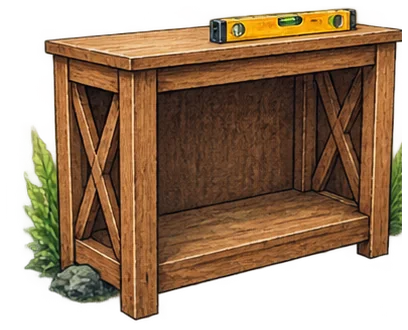
Water is heavy, and an aquarium concentrates a lot of it in a small space. A 75 gallon tank weighs about as much as five adults, and unlike five adults it never moves. Most of the time a floor handles this without trouble. The cases that go wrong are predictable: a large tank on an upper floor, running along the joists in the middle of a span, on a stand that does not support it properly.
How much a filled tank weighs
The U.S. Geological Survey measured a gallon of tap water at 70°F at 8.329 pounds.1 The rounded figure used throughout the water industry is 8.34 pounds per gallon.2 Salt water is denser,1 at roughly 8.55 pounds per gallon for aquarium strength.
Water is only part of the load. Add glass, gravel and rock, and a set-up freshwater tank comes to about 10 pounds per gallon, the rule of thumb given by both Aqueon and WetWebMedia.34 Our weight calculator works it out piece by piece.
| Tank | Empty | Filled, 2 in gravel | On its footprint |
|---|---|---|---|
| 10 Gallon | 10 lb | 115 lb | 83 lb/sq ft |
| 20 Gallon Long | 23 lb | 229 lb | 92 lb/sq ft |
| 29 Gallon | 42 lb | 323 lb | 129 lb/sq ft |
| 40 Gallon Breeder | 54 lb | 457 lb | 102 lb/sq ft |
| 55 Gallon | 90 lb | 616 lb | 142 lb/sq ft |
| 75 Gallon | 123 lb | 842 lb | 140 lb/sq ft |
| 90 Gallon | 137 lb | 980 lb | 163 lb/sq ft |
| 125 Gallon | 178 lb | 1,360 lb | 151 lb/sq ft |
| 180 Gallon | 286 lb | 1,974 lb | 164 lb/sq ft |
Our estimates from glass thickness, water at 8.34 lb per gallon, and two inches of gravel. Rock, wood and equipment add more.
What a house floor is designed for
The International Residential Code, used for most US houses, sets a minimum design live load of 40 pounds per square foot for rooms other than bedrooms, and 30 pounds per square foot for sleeping rooms.5 “Live load” means everything that is not the building itself: people, furniture and contents.6 Note that the 30 psf figure follows the room’s use, not the floor level, so an upstairs living room is still designed for 40.
That 40 psf assumes the load is spread over the whole floor.7 An aquarium is the opposite: all its weight sits on its footprint. A 55 gallon tank at around 616 pounds on a 48 by 13 inch base presses on that patch at about 142 pounds per square foot, more than three times the design figure. Fine Homebuilding’s forum gives a similar worked example, where about 1,800 pounds of water on a 7 by 2 foot footprint comes to at least 131 psf.8
That does not mean the floor will fail. Design loads include safety margins, joists share load with their neighbors, and the floor around the tank carries little. But it does mean a big tank is a concentrated load the floor was not specifically designed for, and the code numbers are minimums. The Journal of Light Construction, discussing heavy concentrated loads such as large hot tubs, advises consulting an engineer.6
Where to put a large tank
- On a slab if you can. A concrete slab on the ground is the strongest place for a tank.7 Basements and slab-on-grade ground floors take almost anything you can carry in.
- Across the joists, not along them. Placing the tank perpendicular to the joists spreads the weight over several of them instead of one or two.9 Joists are usually 16 inches apart,7 so a 48 inch tank across them sits on three or four.
- Near a load-bearing wall. The closer to a supporting wall or beam, the shorter the lever arm. Reef Builders advises placing a tank over a load-bearing wall whenever you can.9
- Not in the middle of a long span on an upper floor, where the floor flexes most.
Fish Tank Advisor suggests structural stability becomes the main concern from around 125 gallons up.7 Below that, a well-placed tank on a sound floor is rarely a problem. Above it, or if your house is old, the floor bounces when you walk, or you plan to put the tank upstairs, a structural engineer’s visit costs far less than a collapsed floor.
A worked example
You want a 75 gallon in an upstairs living room. Filled with gravel it weighs about 842 pounds, and the stand adds more. On its 48 by 18 inch footprint, that is around 140 pounds per square foot. You find the joists run front to back in the room, so you turn the tank to sit across them, along the outside wall where the joists bear on the wall plate. The tank now rests on three or four joists right next to their support, rather than mid-span on one or two. If the floor flexes when you bounce on it, or the house is old, that is the point to call an engineer before filling it.
What the stand has to do
A stand sold for a specific tank is designed for its weight; Aqueon’s advice is to make sure the base is level and does not wobble on an uneven floor.10 WetWebMedia stresses that the stand must support the tank completely along its edges or bottom, so the frame does not twist and stress the seals.4 A tank that rocks even slightly on its stand is under strain at the corners.
- Rimmed glass tanks rest on their plastic frame, so a stand needs to support the full perimeter. Small level errors can be shimmed under the stand.11
- Rimless tanks sit on the bottom glass itself. A leveling mat under them stops a grain of sand from creating a pressure point that cracks the glass, but a mat does not fix a stand that is out of level, and no part of the tank should hang over the edge.12
- Furniture is not a stand. Dressers and bookcases are not built for a load that never moves, and particleboard sags when wet. Small tanks are the exception, and even then check that the top is solid.
Level first, then fill. Check the stand with a spirit level in both directions before the tank goes on, and again with a few inches of water in it.
If you rent
A failed tank can damage more than your floor. Renters insurance usually covers sudden, accidental water damage to your own things, and its personal liability part can apply if you are found responsible for damage to the building or a unit below.13 The landlord’s policy generally covers the building itself.14 Gradual leaks are often excluded,13 so a slow drip from a cracked seam is your problem to catch early. Check your lease too, since some limit tank sizes.
A quick check of your floor
You can learn a lot about where to put a heavy tank without opening anything up:
- Find the joist direction. In a basement or crawl space you can see them. Upstairs, floorboards usually run across the joists, and nail lines in the subfloor or a stud finder will show where they are.
- Find the supports. Exterior walls and walls that sit over beams or walls on the floor below carry the joist ends. The floor is stiffest close to them.
- Do the bounce test. Stand where the tank will go and rock on your heels. If the floor flexes noticeably, or china rattles in a cabinet nearby, choose another spot or get advice.
- Check the age and condition. Older houses were built to older standards, and joists are sometimes notched or cut for plumbing under bathrooms and kitchens.
None of this replaces an engineer for a very large tank, but it will steer a 55 or 75 gallon tank to the best spot in the room.
Common mistakes
- Ignoring the stand’s rating. A stand for a 75 is not automatically right for a 90 on the same footprint; the 90 weighs about 140 pounds more.
- Moving a tank with water in it. Even an inch of water and the gravel adds a lot of weight and stresses the seams. See our moving guide.
- Skipping the level check. Twisting stress on a tank shows up months later as a leaking corner.
- Putting the heaviest tank in the bounciest room. If the floor flexes underfoot, it will flex under a ton of water.