Fish produce ammonia constantly, through their gills and in their waste, and uneaten food rots into more of it. In a lake that ammonia is diluted and broken down. In a closed glass box it builds up until it poisons the fish. “Cycling” means growing a population of bacteria in the filter that converts that ammonia into something far less harmful before the fish arrive, or at least before you add many of them.
What is actually happening
Two groups of bacteria do the work. One, which the University of Florida’s teaching material names as Nitrosomonas, turns ammonia into nitrite. A second, Nitrobacter, turns nitrite into nitrate.1 That two-step picture is what your test kit measures.
Each stage matters because each chemical behaves differently:
- Ammonia. At low levels it stresses fish and damages their gills; at higher levels it kills.2 Its toxic form, un-ionized ammonia, is about 100 times more toxic than the ionized form, and the toxic share rises as pH and temperature rise.2 A reading that is tolerable in soft, cool water can be dangerous in warm, hard water.
- Nitrite. Toxic at levels as low as 0.10 mg/L.2 It binds to the fish’s hemoglobin, which is why nitrite poisoning is called brown blood disease.1
- Nitrate. Much less toxic. The UF/IFAS extension paper notes it was long considered harmless up to about 200 mg/L,2 though most keepers aim much lower and remove it with water changes.
Hobby test kits measure total ammonia, both forms together, so treat any reading above zero in an established tank as a warning.2
How long it takes
Estimates vary. The University of Florida’s module says most biological filters take one to six weeks and sometimes more than eight.1 The UF/IFAS ammonia publication says six to eight weeks.2 Practical Fishkeeping says four to six weeks for most tanks.3 Plan on a month at least and be pleasantly surprised if it is quicker.
Method 1: fishless cycling with ammonia
This is the method most guides now recommend, because no fish are exposed while the bacteria grow. You feed the empty tank pure ammonia as if it had fish in it.
- Set up the tank fully with substrate, filter and heater running, and tap water treated with a conditioner that neutralizes chlorine and chloramine.
- Dose ammonia. Sources differ on the target. Aquarium Co-Op’s fishless ammonia product aims for 2 ppm and warns that going above 5 ppm may actually slow the cycle.4 Practical Fishkeeping recommends 3 ppm.3 Anywhere from 2 to 3 ppm is a sound starting point. Use plain ammonium chloride or unscented ammonia with no surfactants.
- Test every day or two for ammonia and nitrite. For the first week or two you will see ammonia only. Then nitrite appears and ammonia starts to fall.
- Re-dose when ammonia drops to keep the bacteria fed. Mississippi State’s aquaculture fact sheet describes the pattern: ammonia rises then falls, nitrite climbs after a lag, and the peak of the nitrite curve marks the point where the second group of bacteria has taken hold.5
- Watch for the finish line. Practical Fishkeeping’s test is that a full dose of ammonia drops to zero within 24 hours.3 Aquarium Co-Op adds that you should then read zero ammonia, zero nitrite and some nitrate.6
- Do a large water change to bring nitrate down, then add fish within a day or two so the bacteria do not starve.
A worked example
Say you are cycling a 20 gallon long with 2 inches of gravel. Our volume calculator puts the actual water at about 15 gallons once the gravel and an inch of gap at the top are allowed for. That figure, not the 20 on the label, is what you dose against. If your ammonia product says a certain number of drops per gallon raises the level by 1 ppm, multiply by 15, not 20, or you will overshoot.
A typical log might read: days 1 to 9, ammonia 2 ppm and slowly falling; day 10, nitrite appears; days 14 to 21, nitrite reads off the chart while ammonia now clears overnight; day 26 onward, nitrite falls to zero; day 30, a 2 ppm dose is gone in under 24 hours with zero nitrite. That tank is cycled.
Method 2: cycling with fish in the tank
Possible, but harder on the fish and on you. Practical Fishkeeping calls it labor-intensive and risky, and says to do a large water change whenever ammonia or nitrite reaches 0.1 ppm.3 That means testing daily for weeks. If you go this way, start with only a few hardy fish, feed lightly, and accept that you will be changing a lot of water.
Ways to speed it up
- Seed it. The fastest start is to move media from a filter that is already cycled. The Mississippi State fact sheet calls this the most effective way to introduce the bacteria.5 A sponge or a handful of ceramic rings from a friend’s healthy tank can cut weeks off the process.
- Warm it up a little. Warmer water speeds the biology. The same fact sheet suggests raising temperature only a few degrees above the planned running temperature.5
- Keep pH up. The nitrite-processing bacteria become very inefficient at pH 6.5 or below,1 and Practical Fishkeeping says they effectively stop working below pH 6.3 A cycle that stalls with nitrite stuck high is often a pH crash.
- Bottled bacteria. Manufacturers say their products let you add fish right away; API says so for Quick Start7 and Seachem says fish can go in at any time if Stability is dosed for seven days.8 Practical Fishkeeping is more cautious and says bottled bacteria cannot be relied on to cycle a tank quickly.3 Use them as a helper, and test anyway.
Reading your test results
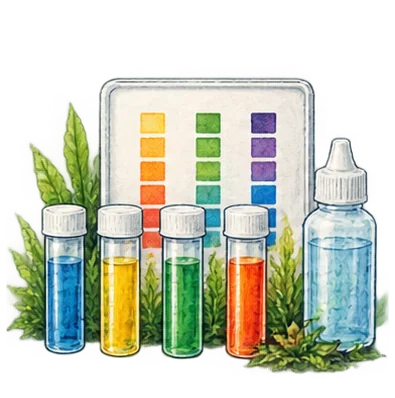
A cycle is easier to judge if you know what each stage looks like on the test card:
- Ammonia high, nitrite zero. Week one or two. The first bacteria have not caught up yet. Keep dosing and wait.
- Ammonia falling, nitrite rising. The first bacteria are working. This is progress, even though nitrite looks alarming.
- Ammonia zero within a day, nitrite off the chart. The second group lags behind. This stage often lasts the longest. Check pH; if it has dropped toward 6, the bacteria slow down.1
- Nitrite stuck high for weeks. Usually a pH crash or very soft water. A partial water change brings nitrite down and restores buffering.2
- Ammonia and nitrite zero, nitrate rising. Done, as long as a full ammonia dose still clears in a day.
Write the readings down. A simple log of date, ammonia, nitrite, nitrate and pH makes stalls obvious and tells you when to stop worrying.
Common mistakes
- Adding all the fish at once. A cycled filter is sized to the waste it has been fed. Practical Fishkeeping advises building up stock gradually rather than adding the full load in one go.3
- Overfeeding. The UF/IFAS paper calls overfeeding a major cause of high ammonia.2 Feed what the fish eat in a minute or two.
- Cleaning the filter too hard. The bacteria live in the filter media. Rinse it lightly in old tank water and never replace all of it at once. See our filter guide.
- Forgetting chloramine. Many water supplies use chloramine, which releases ammonia when it is broken down.9 Use a conditioner rated for both chlorine and chloramine.
- Letting soft water crash. In water with very low alkalinity, pH can drop quickly and kill both fish and nitrifying bacteria.2
If ammonia shows up later
A spike in an established tank usually means something died, the fish were overfed, or the filter was cleaned too hard. The UF/IFAS paper’s first steps are to cut back or stop feeding and to change 25 to 50% of the water, provided your tap water has no ammonia of its own.2 Once things are stable again, Aquarium Co-Op suggests a partial water change any time nitrate reaches 40 ppm or more.6 Our water change guide covers how much and how often.