A cycled filter turns toxic ammonia into nitrate, but nothing in an ordinary tank removes the nitrate. It builds up week after week, along with dissolved waste and the residue of fish food. Water changes are how it leaves. Practical Fishkeeping puts it simply: water changes are mainly for controlling nitrate, which keeps rising over time.1
How much, and how often
Sources cluster around a quarter of the tank, but they differ on details:
- Practical Fishkeeping: about 25% once a week works for most people, adjusted to the tank.1
- Aquarium Co-Op: around 30% per change, on a schedule set by how heavily the tank is stocked rather than a fixed day.2
- A veterinary article on the Veterinary Information Network: 25% changes, weekly in new tanks and once or twice a month in established ones.3
- WebMD’s pet pages: 10 to 15% weekly for small tanks, around 20% for larger ones, and never more than 25% at once.4
The common ground is regular, moderate changes. A small, crowded tank or one with big messy fish needs more; a large, lightly stocked planted tank needs less. Rather than pick a rule, test.
Let nitrate decide
A nitrate test turns the guesswork into a number. Opinions on the limit differ: the VIN article suggests changing water once nitrate passes 20 mg/L (ppm),3 while Aquarium Co-Op treats anything below 40 ppm as safe for most fish.2 Practical Fishkeeping adds a useful test: compare the tank to your tap water, and if the tank reads more than 40 ppm higher, you need to change more water, more often.1
A practical target is to keep nitrate under 20 to 40 ppm, and to set your change size and frequency so it never climbs past that between changes.
A worked example
You have a 29 gallon with two inches of gravel. Our volume calculator puts the actual water at about 24 gallons when it is filled an inch below the rim. Your tap water reads 5 ppm nitrate. You test right after a water change and again a week later, and find nitrate rises about 10 ppm a week.
Each change removes a share of the nitrate and replaces it with tap water at 5 ppm. Over a few weeks the tank settles at a level where the weekly rise and the weekly removal balance out. That level, measured just before a change, is the tap reading plus the weekly rise divided by the fraction you change: 5 + 10 ÷ 0.25 = 45 ppm for 25% a week. That is above the 40 ppm comfort line. Changing 40% a week brings it to 5 + 10 ÷ 0.4 = 30 ppm. Two 25% changes a week, each against a 5 ppm rise, gives 5 + 5 ÷ 0.25 = 25 ppm. The same arithmetic works for any tank once you know how fast nitrate rises in yours.
For this tank, 40% is about 10 gallons, two full buckets.
Treating the new water
Most US tap water is disinfected with chlorine or chloramine, and both harm fish. Chlorine evaporates if water stands, but chloramine does not. A city utility handout from Sioux Falls, South Dakota explains that free chlorine dissipates in a day or two, while chloramine may take weeks.5 Advice to “let tap water sit for three days”4 only works if your supply uses chlorine; check with your water utility, or simply use a conditioner every time.
Chloramine also releases ammonia when it is broken down, which the University of Florida’s aquarium setup publication flags as something to watch.6 Conditioners such as Seachem Prime remove chlorine and chloramine and bind the resulting ammonia. Seachem’s dose is 5 ml per 50 US gallons of new water, and it notes that Prime does not remove ammonia, nitrite or nitrate, so it is not a substitute for water changes.7 Dose for the volume of new water you add, or for the whole tank if you add conditioner directly to the aquarium.
Match the temperature. Aquarium Co-Op says to refill with water roughly the same temperature as what you removed.8 A swing of just a few degrees Celsius can shock fish.9 A thermometer in the bucket takes the guesswork out.
Cleaning the gravel while you are at it
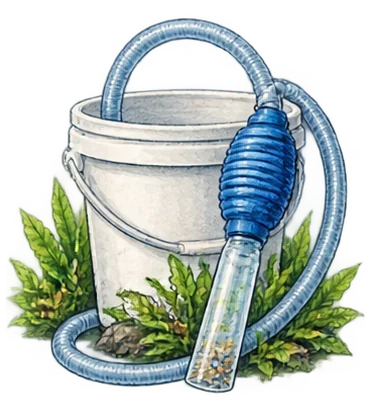
A gravel vacuum is a siphon with a wide tube on the end. Gravity pulls water and debris out of the tank,8 so the same action that removes old water also lifts waste out of the substrate. Aquarium Co-Op suggests vacuuming about a third of the substrate at each change, rotating around the tank,8 which avoids disturbing the whole bed at once. In planted areas, skim the surface rather than digging into the roots.
The neglected-tank trap
It seems logical that a tank which has gone months without a water change needs a huge one. It can be the opposite. As waste builds up, the water’s buffers are used up and pH slowly sinks.10 PetMD notes that when pH drops below about 6.0, the filter bacteria struggle to process ammonia, and that too much change to very clean water can kill fish.11 A sudden rise in pH turns the ammonia the fish have been tolerating into its far more toxic form.9
A California fish veterinarian’s handout on “old tank syndrome” recommends starting with small changes of 10 to 15% daily for a week, then building up gradually, and specifically not doing one big change.10 If you inherit or rescue a neglected tank, test pH and ammonia first and bring it back slowly.
Top-offs are not water changes
When water evaporates, everything dissolved in it stays behind, so topping up only with tap water slowly concentrates minerals and hardness.12 Aquasabi suggests topping up with reverse osmosis or demineralized water for that reason.12 Topping up is fine between changes; it just does not remove anything.
If you are on well water
Well water has no chlorine, but it can carry its own problems. A Southern Regional Aquaculture Center fact sheet, written for fish farms, notes that groundwater can be low in oxygen, high in carbon dioxide and carry iron or hydrogen sulfide, and needs aerating before animals are exposed to it.13 For a home tank, test your well water before use and let it stand with an air stone for a day.
A simple routine
- Test nitrate (and, in a new tank, ammonia and nitrite) before you start.
- Unplug the heater and, for a hang-on-back filter, the filter.
- Vacuum about a third of the gravel while you siphon out the planned amount of water.8
- Wipe the inside of the glass, then rinse a clogged filter sponge in the bucket of old water.
- Refill with conditioned water at a matching temperature.78
- Plug everything back in and check the heater light and the filter flow.
Keep the buckets, siphon and sponge only for the aquarium. Soap residue in a household bucket can harm fish.
Common mistakes
- Skipping changes because the water looks clear. Nitrate is invisible.
- Changing the filter media on the same day as a big gravel clean. Spread the disturbance out.
- Dosing conditioner for the bucket but forgetting the bucket was 5 gallons, not 2. Dose for the full volume of new water.
- Giant catch-up changes in a neglected tank. Small and frequent, then build up.