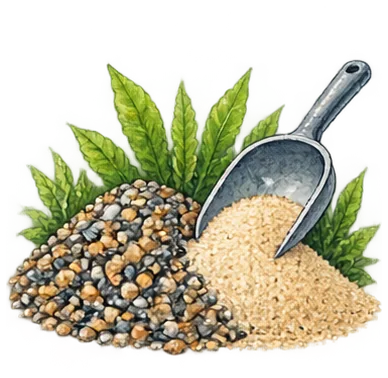
Substrate is the one part of a tank you cannot easily change later. Swapping it means taking out the fish, the plants and most of the water. Choose it with the fish and plants in mind, before the tank is filled.
Inert or active
The first split is whether the substrate changes your water. Gravel and most sand are inert: Buce Plant notes that gravel does not change the water parameters of the tank it is in.1 Seachem’s Flourite, a clay gravel made for planted tanks, is also inert and does not alter pH.2
Active substrates do change the water, on purpose:
- Aquasoils lower pH and soften water. A retailer listing for ADA Aqua Soil Amazonia says it brings pH down to about 5.5 to 6.5.3 Fluval Stratum supports neutral to slightly acidic water, with the effect depending on how hard your water is.4 Buce Plant warns that some soils release ammonia when first added, and that their nutrients run down after a year or two, after which root tabs top them up.1
- Crushed coral and aragonite raise hardness and pH. Aquarium Co-Op says crushed coral significantly boosts KH, which keeps pH from swinging, and that it dissolves faster the lower your pH is.5 Aragonite-based sands such as CaribSea’s African cichlid mixes are made to hold the high pH that Rift Lake cichlids need.6 Aquariumscience.org notes these substrates lift pH to around 7.6 to 7.9 and not much beyond.7
Match the substrate to the water your fish want. Our fish pages list each species’ pH range; the cichlid page shows how far apart soft-water and hard-water cichlids are.
Gravel, sand or soil
Gravel is cheap, easy to vacuum, and lets water pass through it. The downside is that waste and uneaten food fall into the gaps,1 so it needs regular vacuuming. Aquariumscience.org, a hobbyist reference, prefers natural gravel over play sand partly because sand wears out magnetic pumps much faster.7
Sand packs tightly, so debris sits on top where it is easy to siphon, but fine sand can be sucked into a siphon or filter.8 It is the right choice for bottom-sifting fish. Practical Fishkeeping strongly recommends fine sand for corydoras, which can damage their barbels feeding in gravel.9
Planted-tank soil feeds roots and softens water, at the cost of being lighter, messier to replant in, and slowly breaking down.1 Many aquascapers use soil under a cap of sand or gravel.
Is deep sand dangerous?
You will read warnings that sand compacts and forms pockets of toxic gas. Hepper says these pockets can harm or kill fish and plants when disturbed,8 and Bulk Reef Supply says compacted sand can cause problems and suggests stirring it or keeping fish that dig.10 Aquariumscience.org argues the toxic gas danger is exaggerated and that substrate in an aquarium is low in oxygen but never fully without it.117 The practical answer is the same either way: keep sand at two inches or less unless you have plants or burrowing animals to turn it, and stir it during water changes.
How deep
Most guidance falls between one and three inches. Aquariadise gives 1 to 3 inches as a general range and at least a couple of inches for planted tanks.12 Buce Plant recommends at least 1.5 inches (about 4 cm) of soil for good root growth.1 The University of Florida’s aquarium publication, written for tanks with undergravel filters, calls for two to three inches of gravel over the plate.13
A common approach for planted tanks is to slope it: shallow at the front for the look and for easy cleaning, deeper at the back where the tall plants root. Retailers of Tropica’s soil suggest exactly that, making the layer thicker toward the back.14
How much to buy
LiveAquaria’s rule of thumb is a pound of substrate per gallon for a one inch bed and two pounds per gallon for two inches.15 It is a handy shortcut, but it only works for tanks of a typical shape, because substrate covers the floor, not the volume. A tall tank has less floor per gallon than a long one.
Compare a 29 gallon and a 30 gallon breeder. They hold almost the same water, so the pound-per-gallon rule gives the same answer for both, about 60 pounds for two inches. But the 29 is 30 × 12 inches on the floor and the breeder is 36 × 18. Our substrate calculator works from the footprint: two inches of gravel is about 39 pounds in the 29 and about 70 pounds in the breeder. Follow the rule of thumb and you would buy far too much for one and too little for the other.
For soil sold by the litre, multiply length by width by depth in centimetres and divide by 1,000.14 A 36 by 18 inch tank (about 91 by 46 cm) with 5 cm of soil needs about 21 litres.
Rinsing
Gravel and sand are dusty out of the bag. Bulk Reef Supply’s method is to fill a bucket about a third full, run a hose to the bottom, and let it overflow until the water runs clear.16 Do it outside. Two exceptions: do not rinse live sand,16 and do not rinse products packed in a conditioning liquid, such as CaribSea’s Eco-Complete African cichlid substrate, whose bag says to add it without rinsing.6 For soils, Fluval suggests a gentle rinse in a colander to remove dust,4 while many other soils are added dry; follow the bag.
Changing substrate in an established tank
Sometimes the substrate you chose turns out wrong: gravel for corydoras that should be on sand, or a soil that has run out of nutrients. Swapping it in a running tank is possible if you work in sections. Remove a third of the old substrate, add the new in its place, and wait two weeks before doing the next third. Much of the filter bacteria lives in the substrate, so changing it all at once can set off an ammonia spike like a new tank. Keep testing for ammonia and nitrite while you work.
If you are moving to sand, add it gently with the water level lowered, and pour it into a cup or bag placed on the bottom rather than dropping it from the surface. Expect some cloudiness for a day.
Capping soil
A common planted-tank method is to lay soil and cap it with an inch of sand or fine gravel. The cap keeps soil from clouding the water when you replant and stops bottom fish digging it up, while roots still reach the nutrients below. The cap is inert, so the soil’s effect on pH continues underneath it.1
Quick picks by tank
- Community tank with corydoras: fine sand, one to two inches.9
- Planted tank: soil or a plant substrate at least 1.5 inches deep, capped if you like.1
- African rift lake cichlids: aragonite or a cichlid sand to hold pH up.6
- Soft-water fish such as rams or discus: inert sand or gravel, or an aquasoil, never crushed coral.
- Goldfish: sand, or gravel too large to swallow, kept shallow and vacuumed often.
Common mistakes
- Crushed coral in a soft-water tank. It will push pH up for months. Keep it for hard-water fish.
- Aquasoil in a tank of African cichlids. It does the opposite of what they need, and they will dig it up.
- Sharp gravel with corydoras or loaches. Use fine sand or very smooth, small gravel.
- Buying by the gallon rule for a tall or breeder tank. Use the footprint.
- Skipping the rinse and spending a week with cloudy water.