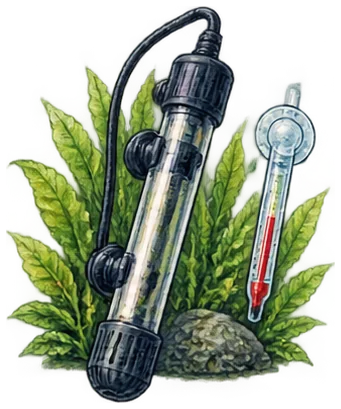
A heater does not make a tank warm by being big. It switches on and off to hold a set temperature, and its wattage only decides how fast it can catch up when the room pulls heat out of the water. Too small and it runs constantly and never reaches the set point on a cold night. Too large and a heater that sticks in the on position can cook a small tank in hours. Sizing is a balance between those two failures.
The rules of thumb, and why they differ
The figure you will see most often is 5 watts per gallon, which is the rule Aquarium Co-Op gives.1 Fishkeeping World gives a looser range of 2.5 to 5 watts per gallon and says the right number moves with room temperature and tank size.2 Seriously Fish works in metric: the heater’s wattage should equal or slightly exceed the tank’s volume in litres.3 Since a US gallon is 3.785 litres, that comes to roughly 3.8 watts per gallon.
Manufacturer charts sit at the low end. Fluval rates its 150 W M-series heater for tanks up to 45 US gallons, about 3.3 watts per gallon.4 Marineland’s Precision chart rates 100 W for tanks up to 29 gallons and 200 W up to 55 gallons,5 and Cobalt’s Neo-Therm chart gives almost the same figures.6
The reason for the spread is in the small print. Marineland’s ratings assume the heater only needs to lift the water about 15°F above the room.5 Fluval says that once the gap between room and set temperature passes 18°F (10°C), you will probably need more heating capacity.4 In other words, the chart numbers assume a heated home. Five watts per gallon gives headroom for a cool basement or a tank by a drafty window.
A worked example
Say you have a 29 gallon tank that you want at 78°F, and the room sits at 68°F in winter. That is a 10°F lift, comfortably inside the manufacturers’ assumptions, so their charts apply: Marineland and Cobalt both put a 100 W heater at the edge of its range for 29 gallons and a 150 W heater comfortably inside it.56 A 150 W heater, about 5 watts per gallon, is the safe choice.
Now move the same tank to a garage that drops to 55°F. The lift is now 23°F, past Fluval’s 18°F line,4 and well past what Marineland’s ratings assume. Here you would want 200 to 250 W, ideally split between two heaters. An insulating background on the back glass and a lid also cut heat loss a great deal.
Heater sizes for standard tanks
These are the sizes we list on each tank page. They work out to about 4 to 5 watts per gallon for a room at normal household temperature, and switch to two heaters from 90 gallons up.
| Tank | Water to the brim | Heater |
|---|---|---|
| 2.5 Gallon | 2.5 gal | 25 W |
| 5 Gallon | 5.5 gal | 25 W |
| 10 Gallon | 10.4 gal | 50 W |
| 15 Gallon | 15 gal | 75 W |
| 20 Gallon High | 19.9 gal | 100 W |
| 20 Gallon Long | 18.7 gal | 100 W |
| 29 Gallon | 28.1 gal | 150 W |
| 30 Gallon Breeder | 33.7 gal | 150 W |
| 33 Gallon Long | 32.4 gal | 150 W |
| 37 Gallon | 37.4 gal | 150 W |
| 40 Gallon Breeder | 44.9 gal | 200 W |
| 55 Gallon | 56.7 gal | 250 W |
| 60 Gallon Breeder | 59.8 gal | 250 W |
| 65 Gallon | 67.3 gal | 300 W |
| 75 Gallon | 78.5 gal | 300 W |
| 90 Gallon | 89.8 gal | 2 x 200 W |
| 120 Gallon | 119.7 gal | 2 x 250 W |
| 125 Gallon | 123.4 gal | 2 x 250 W |
| 150 Gallon | 157.1 gal | 2 x 300 W |
| 180 Gallon | 179.5 gal | 2 x 400 W |
If your room is colder than about 65°F, step up one size or add a second heater.
One heater or two
Aquarium Co-Op suggests buying two smaller heaters rather than one large one, for example two 100 W heaters instead of a single 200 W.1 The reasoning is about failure. The most dangerous way a heater fails is by sticking on. If one of two half-size heaters sticks, it is not powerful enough on its own to overheat the tank, and the other keeps working if one dies. Seriously Fish gives the same advice and adds that two heaters spread heat more evenly.3
On long tanks, put them at opposite ends.2 A six foot tank with one heater at the left end can run a degree or two cooler at the right end.
Where to put the heater
Heat needs to be carried away from the heater, so place it where water moves. Aquarium Co-Op suggests next to the filter output, with the thermometer in the far corner so it reads the coolest water.1 Fishkeeping World prefers near the filter intake;2 either works as long as the heater sits in flow, not tucked behind rocks in still water.
Set a submersible heater at an angle or follow its manual for minimum water depth, and never let the element run in air. Aquarium Co-Op warns that a heater running out of water can burn out or crack, so unplug it before a water change lowers the level.1
Types of heater
- Submersible glass or plastic heaters with a built-in thermostat. The common kind. Accuracy varies: Aqueon lists ±1°,7 while Cobalt lists ±0.5°F for the Neo-Therm.6
- Titanium heaters with an external controller. The element sits in the tank and a separate controller with a probe switches it. Some, such as Finnex’s HMS, cut power if the probe senses the water level dropping, and come with a guard.8
- Inline heaters sit in the return hose of a canister filter or sump, out of the tank entirely. They only work with an external filter.3 Hydor’s ETH, for example, fits 16 mm tubing.9
Whatever you choose, check it with a separate thermometer. The dial on a heater is a target, not a measurement, and Fishkeeping World recommends a separate thermometer even when the heater has its own display.2 Seriously Fish suggests avoiding stick-on strip thermometers because they read the room as much as the water.3
What temperature to set
For most tropical community fish, sources suggest the high 70s Fahrenheit: Aquarium Co-Op says 78 to 80°F,1 Fishkeeping World 76 to 80°F,2 and Seriously Fish says many community fish are fine anywhere from 70 to 82°F.3 Check your species, though. German blue rams and discus want water in the mid 80s, and goldfish need no heater at all in a normal home. The fish pages on this site list each species’ range.
When the power goes out
A tank loses heat slowly, because water holds a lot of it. A large tank in a heated house may drop only a few degrees over several hours, while a small tank in a cold room cools much faster. Keep the lid on and cover the tank with a blanket to slow the loss. If the outage will be long, a battery air pump keeps oxygen up even when the filter has stopped, and warm water in sealed bottles floated in the tank can buy time. When power returns, check the heater has restarted and the thermometer is climbing, and test ammonia over the next day, since filter bacteria suffer when flow stops.
Checking an old heater
Heaters age. Once a year, compare the heater’s set point with a reliable thermometer and look the heater over for cracks, cloudy glass or water inside. A heater that runs constantly without the tank warming, or one that clicks on and off far more than it used to, is worth replacing before it fails. Because the dangerous failure is sticking on, a separate controller that cuts power above a set temperature is cheap insurance on any tank you cannot check every day.
Common mistakes
- Trusting the dial. A heater set to 78 may hold the tank at 75 or 81. Check with a thermometer for a few days after setup.
- Buying one huge heater for a small tank. A 300 W heater in a 20 gallon tank will hold temperature, but if it sticks on it can raise the water past a safe point quickly.
- Leaving it on during water changes. Unplug it before you drain, plug it back in after it has been underwater for a few minutes.
- No guard with bottom fish. Plecos and loaches rest against heaters and can be burned. Seriously Fish recommends a guard where fish hide around the heater.3
- Sizing to the label instead of the room. A tank in a 62°F basement needs more heat than the box suggests.