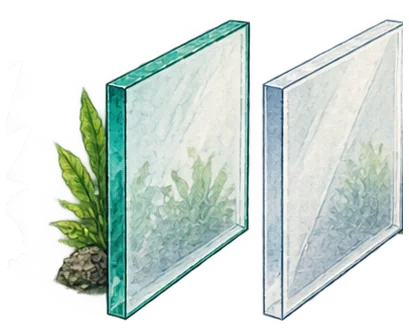
Nearly every standard tank sold in a pet store is glass. Acrylic shows up in odd shapes, very large tanks, and kids’ and desk tanks. Neither is better overall. They fail in different ways, and the right choice depends on the size of the tank, where it is going and how you clean it.
Weight
Acrylic is much lighter. The makers of Perspex and Lucite both describe their acrylic sheet as half the weight of glass.12 For a small tank this hardly matters. For a large one it is the difference between a tank two people can carry and one that needs four.
Remember that the water weighs the same either way. A 125 gallon tank holds over 1,000 pounds of water; acrylic saves on the empty tank, not the filled one. Our weight calculator has a material setting that shows the difference: for a typical tank the acrylic version is lighter empty but only slightly lighter once filled.
Strength
Acrylic is far more resistant to impact. Perspex’s maker says its acrylic is five times as strong as glass;2 a Lucite distributor claims seven times the impact resistance.1 You will see a figure of 17 times repeated online, but we could not find it from a manufacturer, so treat it with caution. The practical point holds either way: a knock that cracks glass will usually not crack acrylic.
Clarity
Clear acrylic transmits about 92% of visible light, which Perspex’s maker says is more than any other product, including glass.2 Ordinary glass has a slight green tint, and Piedmont Plastics notes that thick glass shows more green tint and distortion than thick acrylic.5 Low-iron glass narrows the gap a great deal: Waterbox lists 91% transmittance for the ultra-clear glass on its tanks.3
The advantage grows with thickness. Manta Systems, a custom tank builder, says acrylic tanks are clearer than glass, especially in thicker tanks,4 which is one reason very large display tanks are often acrylic.
Scratches
This is acrylic’s weak spot. Piedmont Plastics, an acrylic distributor, says plainly that acrylic scratches more easily than glass, though light scratches can be buffed out, while scratches in glass are hard to repair.5 Manta agrees that glass is much harder and more scratch-resistant.4
Cleaning has to change accordingly. Bulk Reef Supply says ordinary algae pads are too rough for acrylic, and a single grain of sand caught in a pad can leave a scratch, so never let the pad touch the substrate.6 It also warns against alcohol or ammonia-based cleaners on acrylic, and paper towels on the outside.6 On glass, standard pads and glass cleaner are fine, and some keepers use metal blades to remove stubborn algae.6
Yellowing
Sources disagree. Manta says acrylic can yellow over time from UV exposure.4 The maker of Plexiglas, on the other hand, guarantees its clear sheet against yellowing for 30 years,7 and Lucite’s distributor says it will not yellow under normal exposure.1 A reasonable reading is that good cast acrylic resists yellowing well, while cheaper acrylic, or any acrylic in strong sun, may not. Glass does not yellow.4
How they are built
Glass tanks are panels joined with silicone.4 Standard rimmed tanks such as Aqueon’s add a black plastic frame, with center braces on larger sizes to stop the glass bowing.8 Rimless tanks rely on thicker glass and the silicone alone.
Acrylic seams are chemically welded. Solvent cement softens the two surfaces and fuses them, reaching a full bond after about 24 hours,9 so the joint becomes part of the material. Manta credits acrylic with stronger seam bonds.4
Acrylic can also be bent and formed, so it comes in shapes glass rarely does, such as curved fronts, hexagons and cylinders.4 Clear-for-Life, for example, makes cell-cast acrylic tanks in the USA in a range of shapes.10
Support underneath
Acrylic flexes more than glass, so it needs the whole bottom supported. Aquarium Store Depot’s stand guide says an acrylic tank needs its entire base supported, while a rimmed glass tank can sit on its frame.11 A stand with an open top frame, fine for a rimmed glass tank, is wrong for acrylic. Rimless glass tanks also want a full, flat surface, and the same guide recommends a leveling mat under them.11 Our stand and floor guide covers this in more depth.
Cost
Glass is usually cheaper at the same size.4 As an example of the gap, a Clear-for-Life 10 gallon acrylic tank was listed at $309.99 at PetSmart,12 while an Aqueon 55 gallon glass tank was on sale there for $99.99.13 Piedmont argues that acrylic’s higher price can be partly offset by cheaper shipping and fewer breakages,5 though as an acrylic seller it is not a neutral source. Prices move; check current listings.
A worked example
You want a 125 gallon display in an upstairs room and plan to keep a pleco and some sand-sifting cichlids. Glass would be cheaper and would shrug off the occasional grain of sand caught in a cleaning pad. Acrylic would be lighter to carry upstairs, clearer through a thick front panel, and less likely to crack if a rock shifts. With sand and algae-grazing fish, scratches from cleaning would be a constant risk in acrylic. Here, low-iron glass on a full, level stand is the more practical choice. If the same tank were a custom bowfront going into a ground-floor office with no sand, acrylic would look better.
Low-iron and rimless glass
The clarity gap between the two materials is mostly a gap between acrylic and ordinary float glass. Premium glass tanks close most of it. Waterbox, for example, builds its tanks from licensed Starphire low-iron glass14 and lists 91% light transmittance for the front and sides,3 against 92% for clear acrylic.2 At that point the visible difference is small, and glass keeps its scratch resistance.
Low-iron glass costs more than standard glass, and it is usually paired with a rimless design, which needs a flat, level, fully supported stand and a leveling mat.11 Waterbox also notes that its glass is not tempered, which means it can be drilled for plumbing, though drilling voids the warranty.14 If you plan a sump or an overflow, check before you buy whether the maker sells the tank pre-drilled.
Questions to ask before you buy
- How will you clean it? If you keep sand or gravel and like scraping the front glass hard, glass forgives mistakes that acrylic will show for years.
- How will it get into the room? A large glass tank may need four people and a clear path. An acrylic tank of the same size may need two.
- What will it sit on? Acrylic needs a solid top across the whole base. Many off-the-shelf stands are open frames made for rimmed glass.
- Is the size standard? Standard rectangles are cheapest in glass. Odd shapes, very long tanks and curved fronts are where acrylic earns its price.
- Will it sit near a window? Strong sun favors glass, because of the yellowing question above and because sun drives algae either way.
- Who will be around it? Children, dogs and busy hallways favor acrylic’s impact strength.
Quick comparison
- Choose glass for standard sizes, the lowest price, tanks with sand or gravel near the glass, and easy cleaning.
- Choose acrylic for unusual shapes, very large or thick-panel tanks where clarity and weight matter, and places where a knock is likely.
- Choose low-iron glass if you want most of acrylic’s clarity without the scratching.