A filter does three jobs at once. It strains out particles, it houses the bacteria that turn fish waste into less harmful compounds, and it keeps water moving so oxygen reaches every corner. Flow rate, quoted in gallons per hour (GPH), is the single number most people use to choose one, and it is also the number most likely to mislead you.
The turnover rule
Turnover is how many times the filter can pass the whole tank’s volume through itself in an hour. A 20 gallon tank on a 100 GPH filter has a turnover of 5. Aqueon recommends a flow rate between four and six times the tank’s volume, and at least four.1 Fishkeeping World also sets four turnovers an hour as the floor and points out that the filters bundled in starter kits often manage only two or three.2
The filter flow we list on each tank page uses the same four-to-six range. A 20 gallon long calls for 80 to 120 GPH, a 55 gallon for 220 to 330 GPH.
Why the box number is optimistic
The GPH printed on a filter is usually measured with nothing in the way: no media, no tubing, no height to pump against. Real flow is lower. Bulk Reef Supply explains that once a pump is connected to tubing or pipe, the resistance, called head pressure, cuts the flow, and the higher the lift and the longer the run, the bigger the cut.3
Fluval publishes both numbers for its FX6 canister, which makes the gap easy to see: 925 GPH from the pump alone, 563 GPH of actual circulation through the filter, about 39% less.4 Fluval also reports that ordinary ribbed PVC hose lowered FX flow by 36% over four months as it collected gunk, which is one reason to clean hoses and rinse media regularly.5
So if a filter is rated at exactly four times your tank volume, it will probably deliver less than that in practice. Rounding up a size is sensible. Aqueon’s own advice for hang-on-back and canister filters is to buy one rated at least one size larger than your tank.6
A worked example
You have a 40 gallon breeder. Four to six turnovers means 160 to 240 GPH of real flow. Seachem’s Tidal hang-on-back filters give a useful scale: the Tidal 35 is rated at 130 GPH for tanks up to 35 gallons, the Tidal 55 at 250 GPH for up to 55 gallons.7 The Tidal 55 is the right pick here; the 35 is too small even before you allow for media.
A canister needs the same check, but read the spec sheet carefully. Some makers rate their canisters for much larger tanks than the turnover rule would suggest. Fluval rates the FX6 for aquariums up to 400 gallons,4 yet its 563 GPH of real circulation is only about 1.4 turnovers an hour on a tank that size. Eheim’s classicVARIO+e 250, rated up to about 250 litres, pumps around 510 litres an hour, roughly twice an hour at the top of its range.8 Big canisters hold a lot of media, which partly makes up for slower turnover, but on a heavily stocked tank you would want either a larger filter or a second one.
Choosing a filter type
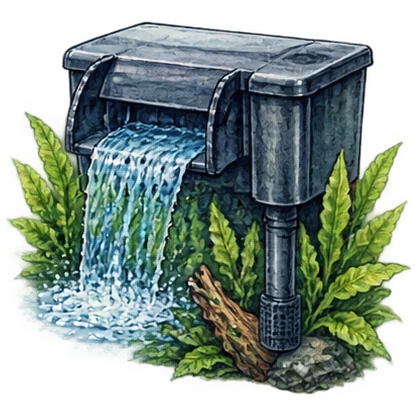
- Hang-on-back (HOB). Hangs on the rim, pulls water up through a tube, and pours it back through media. Cheap and easy to service. Aqueon describes them as best for tanks of 75 gallons and smaller.6
- Canister. Sits in the stand and pumps water through stacked trays of media. Holds far more media and can go longer between cleanings, but takes more work each time you open it.6
- Sponge filter. An air pump drives water through a foam sponge.9 Gentle enough that it will not suck up fry, shrimp or slow fish,10 which makes it the standard choice for betta tanks, breeding tanks and quarantine tanks. On tanks taller than about 22 inches, two sponges can be stacked to reach higher.10
- Sump. A second tank under the display, fed by an overflow and pumped back up. Common on large and marine tanks. For sump return pumps, Bulk Reef Supply calls anything from 2 to 10 turnovers acceptable,3 and Practical Fishkeeping notes that the very high turnover figures sometimes quoted for reef tanks refer to powerheads in the display, not sump flow.11
What goes inside
Aqueon breaks filtration into three stages.9 Mechanical media, usually floss or foam, traps particles. Biological media gives nitrifying bacteria a surface to live on; this is the part that keeps ammonia at zero, and the reason a new filter needs time to cycle. Chemical media, such as activated carbon, binds dissolved compounds and wears out; Aqueon says it may need replacing every four to six weeks.9
Order matters. Water should pass through the mechanical stage first, so the biological media stays clear of debris.
Strong flow is not always better
Some fish want calm water. Aqueon notes that fish with long, delicate fins such as bettas need gentler flow than a danio, and recommends a low-flow filter for a betta tank.1213 The same goes for many shrimp and for slow-swimming fancy fish. If you need the filtration of a big filter but not the current, point the outflow at the glass, add a sponge pre-filter to the intake, or choose a sponge filter.
Sources disagree on how far you can oversize. Fishkeeping World says you cannot over-filter, so bigger is safer;2 Aqueon warns against both under- and over-filtering for your tank’s volume.1 In practice the risk of a large filter is the current, not the filtration, and both problems have the fixes above.
Cleaning media without losing the bacteria
The bacteria live on the media, so cleaning should remove dirt without sterilizing it. Practical Fishkeeping advises rinsing media gently in old tank water and staggering the work: clean around half of the biological media every four weeks rather than all of it at once.14 It also suggests rinsing sponges about every two weeks, with slowing outflow being the clearest sign one is due, and replacing sponges every 12 to 18 months.14
Whether tap water harms the bacteria is debated. Fishkeeping World says chlorine in tap water will destroy them;2 Aquarium Co-Op says old tank water or dechlorinated water are both fine.15 Using water you just siphoned out of the tank during a water change avoids the question entirely, so it is the simplest habit to adopt.
Keep the filter running. Fishkeeping World points out that bacteria inside a stopped filter begin to die from lack of oxygen,2 so do not leave one switched off for hours, and if a power cut lasts a long time, rinse the first slug of water out of a canister before restarting it.
Matching the filter to the tank
Turnover is a starting point, not the whole answer. A few other things change which filter suits a tank:
- Stocking. A heavily stocked tank, or one with goldfish or plecos, produces far more waste than a lightly stocked planted tank of the same size. Aim for the top of the four-to-six range, or add a second filter. Our stocking calculator shows how full a tank is.
- Tank shape. In a long tank, one hang-on-back at one end can leave the far end still. Two smaller filters at opposite ends, or a canister with the intake and outlet at opposite ends, move water along the whole length.
- Height. In a tall tank, the intake should reach within a few inches of the bottom so it pulls debris from where it settles.
- Noise and space. Hang-on-backs need a few inches behind the tank and can trickle; canisters are quieter but need room in the stand.
For a typical community tank, a reasonable plan is a hang-on-back rated at about six times the volume up to 55 gallons, and a canister or two hang-on-backs above that. Sponge filters suit betta, shrimp, fry and quarantine tanks, either alone or alongside a larger filter.
Common mistakes
- Sizing to the box, not the tank. A filter “for up to 40 gallons” may be fine for a lightly stocked 30 and short for a busy 40.
- Replacing all the media at once. Swapping every cartridge in one go throws away most of the bacteria. Stagger it.
- Ignoring the hoses. Canister flow falls as hoses foul. Clean them when you clean the canister.
- Too much current for the fish. Bettas pinned against plants, or fish hiding in corners, are a sign to baffle the outflow.